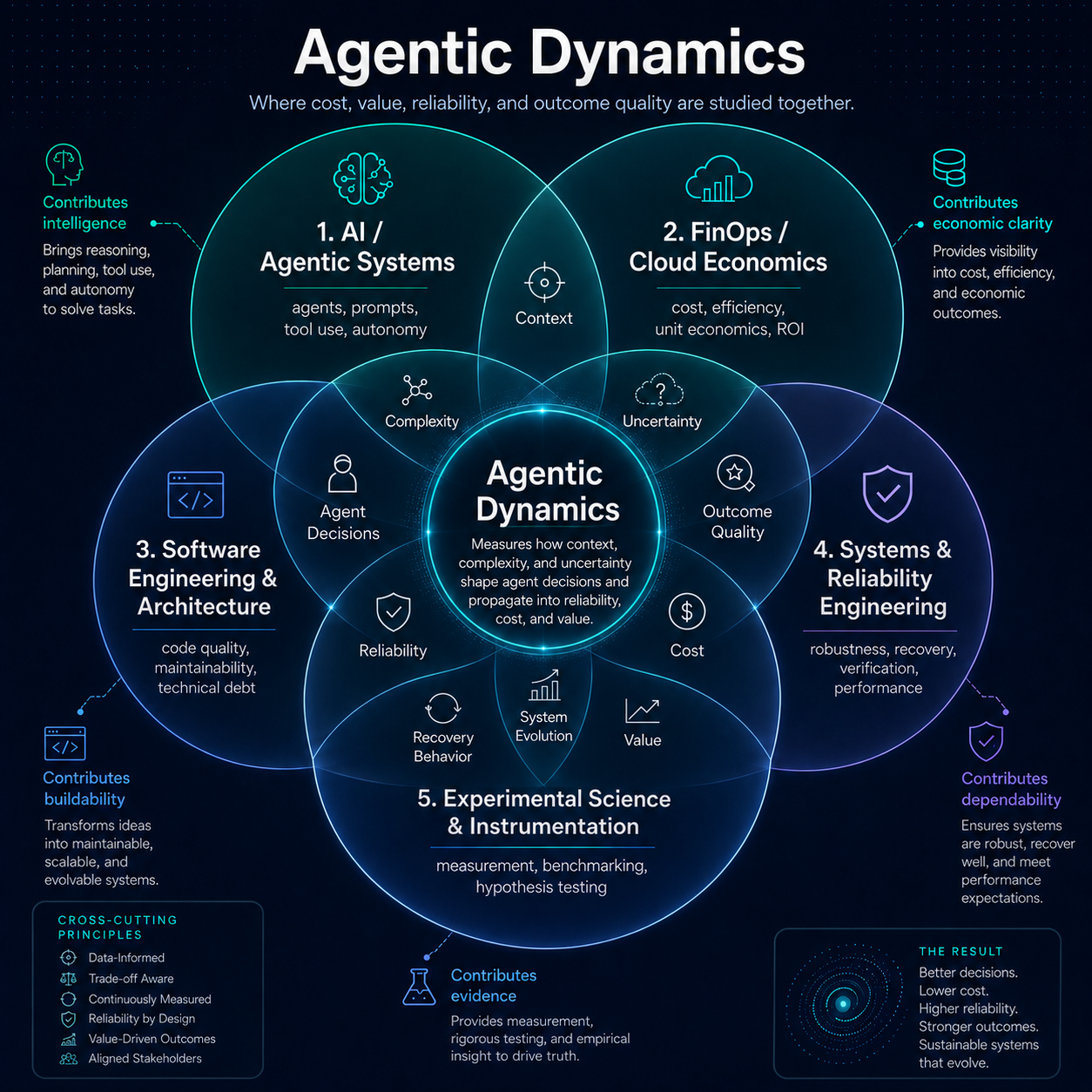
Agentic Dynamics is the empirical study of how AI agents behave, adapt, interact, recover, and produce outcomes across changing tasks, environments, workflows, and time. This repository is its founding instrument and corpus.
“The system shapes the agent — and the agent reshapes the system. Read that again.”
Agentic Dynamics is the empirical study of how AI agents behave, adapt, interact, recover, and produce outcomes across changing tasks, environments, workflows, and time. This instrument currently examines cost, verification, maintainability, recovery, and five-session progression in coding-agent workflows. Routing and long-horizon value remain questions for controlled experiments, not conclusions inferred from a price sheet.
The original question compared one model's cost and quality under degraded input. Answering it properly required N linked sessions, because each output becomes the next session's codebase, and M measurement angles, because passing tests cannot stand in for verification, maintainability, cache economics, routing risk, or long-horizon cost. The corpus is the product of that multiplication, not a larger benchmark.
215 stories across 3 codebases (CRUD API, static site generator, notification service) and 2 tiers, run against 7 models. Every measurement is provenance-tagged; a signal that was not captured is published as null with its coverage, never a fabricated zero. Collection creates one N x M burden; analysis creates a second across models, conditions, tasks, tiers, commits, and story positions. More sessions without analysis are volume, not information.
The supporting corpus contains 1,067 instrumented story sessions. Four findings made the gap concrete.
OpenAI spans a 41× price range — Luna at $0.09 and Sol at $3.75 — and both write ~10 tests per story. Claude spans 2.9× — Haiku at $1.59 and Sonnet 5 at $4.58 — and both write ~120. All pass their tests. In these observed tasks, the 10× verification gap appears between vendors rather than between price tiers; the result describes this corpus, not a universal purchasing rule.
The measured story cost roughly doubles from its greenfield session ($0.16) to its cross-cutting session ($0.34), while tokens grow from 18.7K to 34.9K. Every session inherits a larger codebase, so per-session cost understates the observed maintenance arc by ~2×. Generalizing that mechanism beyond the measured arc remains modeled.
The cheapest model (Flash) and the most expensive (Sol) both send ~47K tokens per session — Flash at $0.07, Sol at $3.75. Luna hits a 98% cache-hit rate and sends just 6.3K. Token volume, cache policy, and test thoroughness appear as three separate knobs in this corpus; their separation does not establish that any one predicts the other two.
Corrupting the session-1 spec (early_degrade) lowers the success rate to 86% (versus 97% clean) and raises the cascade rate (1.5% → 2.5%). Degradation raises risk at the margin; it does not dominate the outcome. Cells labelled bad_seed/early_degrade that carried no instrumented test verdict received no actual perturbation and are counted as clean (docs/data_integrity_findings.md treatment rule 1), so the arms above are the corrected ones.
A model can pass every test it writes and still leave a system unverified. The gap is measured by test thoroughness:
Tests per story: Luna 7 · Terra 9 · Sol 13 · Flash 34 · Pro 34 · Haiku 117 · Sonnet 122
All seven models pass their own tests at roughly equal rates, but the tests differ by an order of magnitude. Luna ships ~7 tests that confirm the happy path. Sonnet 5 ships ~122 that probe edge cases — duplicate usernames, whitespace titles, missing bearer tokens, idempotent notifications. Both codebases "work." One has a much broader observed verification surface.
This is the durable-value gap. Correctness asks whether code passes the tests you have. Verification asks whether you have the tests that would catch the failures that matter. In this corpus, that safety net varies by vendor family, while price alone does not explain the difference.